
By Gary Meyer. (updated August 1 ,2026)
Family dramas, Amazing Sea Monkeys, Hollywood censorship, Woody Guthrie, the Middle East conflicts, Berlin’s nightlife, uncomfortable secrets, teenage angst, many kinds of music, short films, Holocaust stories we never knew, New Yorker cartoonists, LBGTQ lives, inside the most famous Catskills summer resort, and family comedies.
These are some of the stories at the San Francisco Jewish Film Festival playing through Sunday, August 2.
Most film festivals create a trailer made up of brief clips from the program. It is both exciting and frustrating. (Note to other festivals: Please post your clip trailers online with the films’ titles at the bottom and listed in the same order in the video notes.)

But the San Francisco Jewish Film Festival is known for their creative originals that are humorous and feature local actors.
The world’s first Jewish Film Festival, founded by filmmaker Deborah Kaufman in 1980 with a goal of bringing together audiences of unaffiliated Jews. She told the New York Times, “”I wanted to express my Jewishness and my progressive politics and my cultural hipness at the same time. There was no venue like that at the time, so I had to create one.” Soon Janis Plotkin joined her and it grew, inspiring others to start similar events. In response to the interest they published a book, Independent Jewish Film: A Resource Guide, providing advice for creating a film festival, where to get the movies, and much more. They presented a festival in Moscow (1990), the first Jewish cultural event in 50 years, followed in 1992 by a festival in Madrid, 500 years after the Spanish Inquisition and Jewish expulsion.
The Festival, now under the direction of Lexi Leban, has always presented a mixture of features and documentaries exploring difficult issues balanced with entertaining works.
Many films in the festival have received both artistic guidance and financial support through the Jewish Film Institute’s popular Artist Development Programs.
The 46th Festival continues this tradition. And you don’t have to be Jewish be a part of the celebration. Don’t live in the San Francisco Bay Area? Many of these movies may be coming to all kinds of film festivals or cinemas near you. Ask for them.
I present my brief thoughts on a sampling of films I have seen so far. The titles link to descriptions and ticketing on the Festival website.
Download the Program Guide here.
Award winners and an early sell-out have just been announced for Sunday, August 2 at the Piedmont Theater. See the film lineup here.

We’ll start with the festival’s closing night film, We Met at Grossinger’s, a look at the most famous Borscht Belt resort. Decades of prejudice kept Jewish immigrants from mainstream country clubs and resorts but a group of Catskills resorts in upstate New York welcomed them and others from marginalized communities. Grossinger’s opened in 1910 and became the crown jewel; its Queen was Jennie Grossinger who made sure everything was perfect for her guests. She was called “the first woman of hospitality.” The film’s director, Paula Eiselt, told Forbes Magazine, “Jennie was up front, she was the face of it. She wasn’t hiding behind her husband, her husband was hiding behind her.”
A treasure trove of photos and home movies accompanied by contemporary interviews with those who were there, offer us the next best thing to a real visit to the first all-inclusive resort with 35 buildings that accommodated over 150,000 annual visitors at its peak. Guests enjoyed swimming pools, skating rinks, tennis, golf, horseback riding plus a ski slope and a toboggan run using artificial snow. And the food! All you could eat. Dozens of entertainers got their start here, especially stand-up comics (as dramatized in “The Marvelous Mrs. Maisel”): Joan Rivers, Mel Brooks, Milton Berle, Jerry Seinfeld, Sid Caesar, George Burns, Jerry Lewis, Woody Allen, Billy Crystal, Jackie Mason, Danny Kaye, Red Buttons, Jack Benny, Richard Pryor, Rodney Dangerfield and musical performers included Tony Bennett, Steve Lawrence and Edie Gorme, Tito Puente, Sammy Davis Jr., Eddie Fisher, Barbra Streisand, and The Supremes.
Romance was in the air too. Hundreds of teenagers reported to their friends having their first make-out session. Eddie Fisher (who was discovered here) and Debbie Reynolds were married at Grossinger’s (and of course “Dirty Dancing” was inspired by the popular dance contests).
Jennie broke the color barrier when she invited then Brooklyn Dodgers baseball star Jackie Robinson who became a good friend and regular visitor along with other non-Jews who might not be accepted elsewhere.
In the early 70s when Jews were able to stay at other places of their choice and younger visitors were not interested, the resorts went into decline.
Mostly this is a joyous and immersive experience in nostalgia for those who vacationed there and an eye-opening journey back in time for the rest of us.
Dust Bowls and Jewish Souls: Another Side of Woody Guthrie
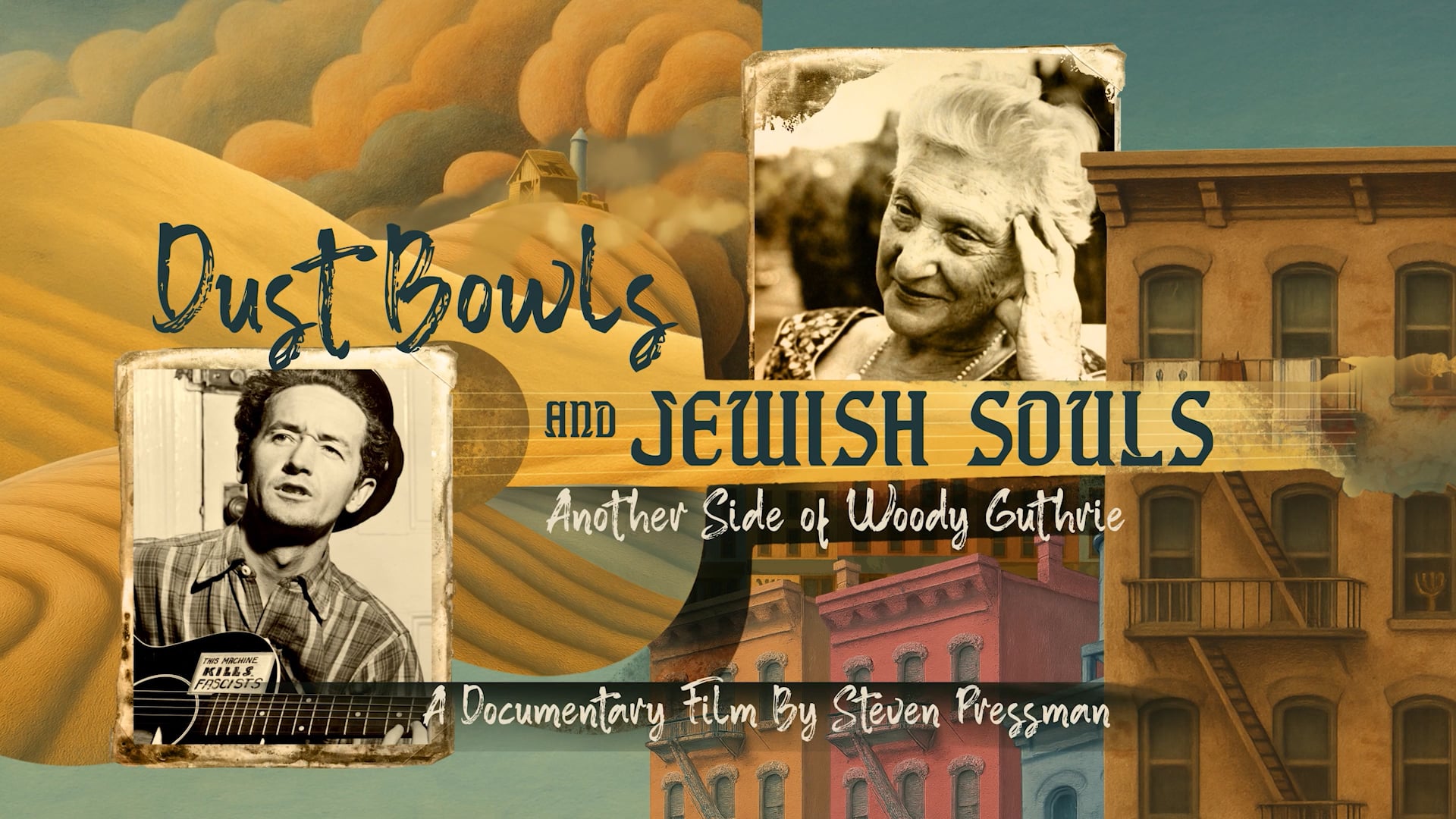
When visiting New York’s Morgan Library filmmaker Steve Pressman saw a sheet of song lyrics: “Chanukah candlelight, see my flame, shining on my window’s pane,” written by the folk musician Woody Guthrie from a tiny town Oklahoma where, Pressman says, “He probably never met a Jew.” Pressman wanted to know more and his discoveries became the basis for this fascinating and entertaining film.
The director learned that Guthrie’s wife, Marjorie, was Jewish. Her mother, Aliza Greenblatt was a Ukrainian immigrant, known for her Yiddish poems and autobiography. Woody became close to her. They collaborated on projects and Woody was inspired to write numerous Jewish themed songs, help with translations of some of her writings into English, and illustrated one of her books.

There was a menorah in the Guthrie home, they went to Sabbath dinners, his son Arlo had a kind of hybrid Bar Mitzvah, and his sister Nora embraced Judaism in her own way. Both are among many who are interviewed with insightful stories to tell. The family provided previously unseen family photos and films to give us a look into a largely unknown side of Guthrie. Most of the movie presents material few have seen while making sure to present important parts of his life. Especially touching are Bobby (Dylan) Zimmerman and Ramblin’ Jack Elliot, both Jews, talking about their visits with Woody at the hospital in his final years.
In my opinion Woody’s “This Land is Your Land” should be our national anthem. The range of his songs is always impressive, and the film has an abundance of great music including performances by the Kelzmatics who recorded two albums of Guthrie’s Jewish-themed lyrics.

A side note: There is a photo of Woody Guthrie singing on a radio show. The microphone has a big CBS logo on it as he actually was part of three series in the 1940s including “Back Where I Come From” (1940) written and produced by Nicholas Ray and “Hootenanny(1947). Listen to a terrific episode of each here. That wouldn’t happen today though ironically the TV network banned Pete Seeger from “The Smothers Brothers Show” in 1967. The Brothers fighting the executives and public protests resulted in Seegar being invited back to perform “Wasit Deep in the Big Muddy” a year later.
EatDrinkFilms is proud to be a Community Partner and co-presenter of “We Met at Grossinger’s” and “Dust Bowls and Jewish Souls: Another Side of Woody Guthrie.”
Another folksinger is the focus of a very different film, The Darkest Light.

In 1966 I attended a concert at San Francisco State University by Rabbi Shlomo Carlebach. It was a joyous evening of beautiful songs and dancing with a sense of community and spirituality shared by Jews and non-Jews alike. When he returned to town, I invited my parents, and we enjoyed several more gatherings together. Then rumors began circulating that young women had not returned to their dorms or apartments after his concerts. They had disappeared for days or weeks after leaving with the rabbi on his travels, reportedly instructed not to reveal where they were. Was this charismatic leader also a sexual predator? The allegations did not become public until 1998, when Lilith magazine published an article four years after his death, though women had already been reluctantly sharing their stories with close friends.
Director Simon Mendes tells Carlebach’s story superbly, showing how deeply people trusted his message of love. When the truth emerged, it stirred controversy within the Jewish community: should synagogues continue using his popular, much-loved music in services? A person can choose whether to see a film, read a book, view art, or listen to music by an artist who has done harmful things. But if you are at a religious gathering and recognize a Carlebach song that feels triggering, what do you do?
The film allows many points of view to be discussed on what continues to be controversial. Three women offer difficult testimonies while others defend him. Both of Carlebach’s daughters are in the film. Neshama’s career as a singer playing some of her father’s music has struggled with the dilemma and ultimately has come to terms with the suffering he caused. She wrote a powerful article in The Times of Israel on the day of the film’s premiere explaining why she was not attending.
“This was not an easy decision. I believe in this film. I believe it deserves to be seen, and I intend to continue supporting it as it travels through the world. But today should not be about me nor about my grief or my struggle to reconcile the father I loved with the man others experienced. Today belongs, first and foremost, to the women whose voices have too often been ignored, questioned, minimized, or dismissed.”
Her sister Dari also appears in the film but now is saying she wishes her interviews were eliminated, according to a report in the Orthodox website VINnews.
The Darkest Light will surely have people talking about the issues for a long time.
It has been honored with the Best First Feature Award and an encore showing has been added on Sunday, August 2 at 3pm at the Piedmont Theatre. Three other award winners, yet to be announced, will show that day.
Interview with director Simon Mendes.
Amazing Live Sea Monkeys also has its share of dark secrets.

When I was a kid Sea Monkeys and Uncle Milton‘s Ant Farms captured our imaginations. (But no mail-order monkey or small dog in a teacup for my menagerie.) This new documentary is about Yolanda Signorelli, the widow of Harold von Braunhut who invented sea monkeys. Harold figured out a formula that could “extend the lives of Brine Shrimp up to two years.” Sales were modest until he discovered that advertising in comic books resulted in big success along with the other 195 novelty items he created and patented such as X-Ray Specs and Invisible Goldfish, usually with misleading promises.
Yolanda, a buxom young beauty who starred in a series of softcore dramas in the 1960s came under his influence. After twelve years he agreed to marry her if they won a Playboy Club wedding contest. When Harold died she got an offer to sell to Big-Time Toys, letting her retain the rights to the secret formula. Sea Monkeys continued to be a hit, but she got hundreds of letters complaining that people’s sea monkeys were dying quickly. It turned out that Big Time was farming out a different formula made in China and the creatures did not survive. They also stopped paying her. Yolanda ran out of money to pay the bills on the estate and wildlife preserve she inherited. The electricity and water were turned off. Yolanda decided to sue Big Time.
There is a lot of fascinating material in this sloppy doc that meanders for 99 minutes in what could have been a terrific piece under an hour. As things progress with a lot of repetition I started thinking, “So what is the Jewish connection here?” since it is in a Jewish Film Festival. Suddenly, as if the filmmakers knew what was on my mind, Yolanda’s much younger boyfriend Brain goes into the basement and discovers that Harold belonged to many white supremist organizations including the KKK, American Nazi Party and was a pastor for the Aryan Nations. But the additional revelation is that he was raised Jewish.
Yolanda is committed to an ethical outcome but the lawsuit seems to be ongoing; payments due have not been made. The film will be released by A24, experts at making successes of their movies. It is unclear what all this means for Yolanda.
Harold’s dark secrets, much publicized at the time it became public, are not mentioned after the revelation segment.
Censorship in Hollywood has a long history.

The Mad Dog of Europe tells a story of the successful Hollywood screenwriter Herman J. Mankewicz who took a leave from MGM in 1933 to write a screenplay for a film he felt America needed to see—a warning about the rise of Fascism and the popular German leader, Adolf Hitler. But Hollywood rejected it, concerned that Germany would ban their movies. In fact, the German ambassador to Hollywood lobbied studios to limit Jewish artists and content in cinema. In 1935 Joseph Goebbels, Minister of Education and Propaganda under Hitler, told MGM that films with Mankiewicz’s name in the credits could not be shown there.
Rubika Shah’s fascinating documentary presents the full story with film clips and interviews about the ups and downs of the project that got “Mank” blacklisted until Orson Welles insisted that he write the screenplay for “Citizen Kane.” But “The Mad Dog of Europe” was never made. This is the closest we will get to it. Without being specific, the movie clearly is a warning about where today’s American film industry could be headed with the pressure from the current administration about what they want made and shown on all screens.
There is a more specific form of censorship that is the focus of Hollywood Does Abortion.

It covers the last fifty years and how the entertainment industry has dealt with this issue starting with the very controversial story line on Norman Lear’s popular TV show, “Maude” in 1972 where Bea Arthur’s character discovers she is pregnant later in life. Her daughter (Adrienne Barbeau) comforts her with support for having the operation without shame. CBS (again) was uncomfortable with this, but Norman Lear was so important to them with his many hit shows that he got his way. Barbeau is interviewed in the film and emotionally discusses the improvements for women’s rights at the time but following the 2022 reversal of Roe vs. Wade she comments, “We’re not free at all.”
And as far as media goes things weren’t as open-minded as they seemed. Other than a few exceptions like “Dirty Dancing,” “Fast Times at Ridgemont High,” and the television shows from power producer Shonda Rhimes, political pressure affected the outcomes in many works where the narrative started one way and then copped out with the characters not having the planned abortion for a variety of reasons. And even those that deal with the issues mostly ignore the racial and economic realities.
This sobering documentary is a must-see.

The Israeli Tell Me Everything is an intriguing reversal of the usual teen coming out narrative where Boaz discovers that his father is gay. With inventive cinematography, creative lighting and an excellent score, director Moshe Rosenthal’s film, set during the 1980, is about a 12-year-old who at first appears to have a comfortable life. His sisters adore him and his parents treat him with great respect. But when his dad’s failed business venture brings police to repossess some of their furniture, his insecurity starts to show in a terrific performance by Yair Mazor. It is not so much what he accidently sees in the swimming pool locker room between his father and another man but as he reads about the HIV-AIDS crisis and sees horror stories on the news, he fears that his family could become infected and possibly die. When his father is outed to the family, he must leave them. Nine years later Boaz lives an emotionally torn life that drives him to try to find his father. What happens is a series of surprises to the end and I found it a satisfying resolution. There are mixed feelings in the queer community – the differences could be heard in the lobby after opening night.
A running joke over the years in the festival’s marketing has been “You don’t have to be Jewish to enjoy the SF Jewish Film Festival.”
The running joke among audience members about a few films each year is, “What is Jewish about this film?”
Why should this festival be different than all others?
Well, after writing these snarky comments the Executive Director of the Festival, Lexi Leban, straightened me out. The festival section, “Next Wave,” features movies by Jewish filmmakers even if there are no on-screen Jewish connections. Ooops. Here is that schedule and both films below are in that category.
“JFI Next Wave is a community of Gen Z and Millennial film lovers as well as a platform for showcasing emerging and established filmmakers whose work explores modern life and identity through a Jewish lens, often dealing with subjects like, art, music, travel, social justice and more.”
Human Theories may have some Jewish characters but I missed the clues. The idea of 40 very short vignettes in 71 minutes could be overwhelming. After the first three I wasn’t sure I wanted to watch more. I was not engaged, but I figured it wasn’t that long and nothing would last for more than two minutes. I am glad I stuck with it. The short stories range from very funny to dramatic, cringy, and touching. A few of the characters reappear but mostly we come to enjoy these fleeting moments, not unlike what we might experience observe or even experience on any given day. Running into a friend you haven’t seen in a long time, having trouble accepting that a roommate is leaving, meeting at a used book stall, those moments in subways, will a blind date go well…or not. You get the idea but you will no doubt find some surprises. And a satisfying jazz score fits the New York location perfectly.
I don’t want to end on a downer but I did save my least favorite film for last.
Do you ever see a movie and come out wondering what other people think? You look up the reviews and find out that you are in the minority. That happened to me with Act One.

Rotten Tomatoes has it listed with a high ratings following high profile film festival showings. Actually, reading the reviews, some are mixed. I wish I could at least be mixed.
Hannah is a 17-year-old who wants to be an actress, but she doesn’t get chosen for her senior high school play. Depressed but determined she seeks out the Act One Studios whose director, Melanie, is locally famous for having developed a few successful actors. Even though her mother said she can’t go to the school, she somehow attends regularly. There she meets a handsome young actor probably in his mid-30s. As they rehearse a scene from William Inge’s Picnic that requires a kiss; they hesitate but she decides to go forward because they’ll have to kiss during the audition. It’s more than a simple kiss.
The teacher invites Hannah to her house one night. The young man is there, and they are encouraged to have sex on the couch as Melanie watches. This is just one of many uncomfortable scenes involving either sex or a major dramatic confrontation where I kept thinking, “Somebody’s going to wake up from a bad dream.”
Unfortunately, that didn’t happen. The film wants to be camp as well as a thriller. Scenes fade to a faux red setting us up for a bloody outcome. The script is ridiculous and predictable right up to so-called twist ending.
Hannah is played by Ella Beatty, daughter of Annette Bening and Warren Beatty. She and Ari Graynor as Melanie have been praised but for me the overacting in a movie about acting made for an unbearable 105 minutes. Maybe it was because I watched it right after my second viewing of Olivia Wilde’s beautifully written, directed, and acted “The Invite.”
For those who see “Act One” I hope I was just not in the right mood.
And I am still trying to figure out the Jewish connection. Maybe it was so obvious I missed it.
Before I close I want to urge you to seek out the films in the four Shorts programs. They are filled with creativity and surprises. There are narratives, unique animation and documentaries.
I am looking forward to the films in From The Bay on Saturday, August 1 but none were available for advance screening.
I did see and enjoy these films.
The complete schedule is on the SFJFF46 Website.
Past years creative Festival trailers can be found here.
Jewish Film Institute Social Media:
Instagram: @sfjewishfilm
Twitter: @sfjewishfilm
Facebook: @sfjewishfilm
LinkedIn: @sfjewishfilm
Hashtags: #SFJFF46 #SFJEWISHFILM
 Gary Meyer started his first theater in the family barn when he was twelve-years-old. He directed a monster movie there and wanted to show it on the set. It became The Above-the-Ground Theatre screening dozens of silent films with music arranged from his parents’ record collection. Over 250 films were screened along with live productions, workshops and the publication of a literary/arts/satire zine, “Nort!” and a film newsletter, “Ciné.” After film school at SFSU he calls his first job as a booker for United Artists Theatres “grad school” that prepared him for co-founding Landmark Theatres in 1975. It was the first national arthouse chain in the U.S. focused on creative marketing strategies to build loyal audiences for non-Hollywood fare. After selling Landmark, he consulted on many projects including Sundance Cinemas and the Brooklyn Academy of Music’s Rose Cinemas, created several film festivals including the Dockers Classically Independent Film Festival and Tube Film Festival for the X Games, and resurrected the 1926 Balboa Theatre in San Francisco. Meyer joined the Telluride Film Festival in 1998, becoming a Festival Co-Director in 2007-2014. He founded the online magazine, EatDrinkFilms.com in April 2014 and consults for festivals while offering pro bono advice to independent filmmakers and cinemas. He started EatDrinkFilms to give a voice to writers wanting to explore food, beverage and the movies from unique perspectives. Meyer, Editor/Publisher, also contributes articles.