
An interview by Geneva Anderson. (March 16, 2026)

Sophoan Sorn. Festival director of Berlin & Beyond at the Castro Theater which screens three German dramas on March 19. Image: Sophoan Sorn
The Berlin & Beyond film festival (B&B) (March 19-23) will celebrate its 30th anniversary in style, with Opening Night at revamped Castro Theater on March 19. The evening unfolds with Ido Fluk’s drama, “Köln 75,” the exhilarating back story to Keith Jarrett’s famously improvised 1975 piano concert, along with a special Opening Ceremony and tribute to actor Mala Emde, who stars in the film.Behind it all is Sophoan Sorn, B&B’s magnetic director, creatively problem-solving to pull this special 30th edition off smoothly. For the past 16 years, Sorn has been at B&B’s helm, shaping this Bay Area festival into the most important vehicle for introducing new trends in German cinema to the U.S. Over its three decades, B&B has screened over 500 films from German-speaking countries to over 200,000 attendees. Produced in over thirty countries, these movies have ranged from critically acclaimed independent works to big studio pictures to impactful documentaries and shorts.
I couldn’t wait to talk with Sorn, a multifaceted artist, classically trained pianist, and very creative thinker, about the mark he’s made on this festival and the challenges he faces in pulling it off year after year.
This year’s five-day festival has a 13 film line-up and runs in San Francisco at the Castro Theater on Thursday; the Vogue Theatre on Friday; SFMOMA’s Phyllis Wattis Theater on Saturday; and in Berkeley at Rialto Cinemas@Elmwood on Sunday and Monday.
What changes you are most proud of bringing to Berlin & Beyond during your tenure?
Sophoan Sorn: Changes can be wonderful. Sometimes they are changes we would like to implement and sometimes they are changes we are forced to make. Every year brings a new monster to tame. We went through a lot to secure our venues this year, especially in this new era of the Castro Theater—we were last there in 2021—and it’s our first time at SFMOMA’s Phyllis Wattis Theater. I’m proud to have been able to continue this festival every single year. There’s no template, no cookie cutter; every single year is curated purely from scratch. Every year we have to select new films and each film has its own business and distribution side and its own release schedule—so every film has to be negotiated to bring it to this festival.
For myself, I’m very proud of bringing new voices to the forefront. There’s a lot of diversity—immigrant stories; films made by immigrant filmmakers and children of immigrant filmmakers; films that connect with BIPOC communities and with the queer communities of the independent film-making scene. This is on top of our programming with the major motion pictures and the major award-winners that are anticipated and that our audience loves to see. We try to find the under-sung new films and to introduce new independent filmmakers who are on the rise. We have big pictures and ‘small’ pictures, recognizing that small can be very significant because someone is pouring their spirit and all they have into that one picture and that’s a huge thing.

Mala Emde as Vera Brandes, the dynamic 18-year-old music promoter in Ido Fluk’s “Köln 75” without whom Keith Jarrett’s celebrated piano recording “The Köln Concert,” might not have happened. Image: Wolfgang Ennenbach/One Two Films
Why aren’t you streaming?
Sophoan Sorn: We have four venues over five days this year. Virtual offerings were discontinued. The reason why we are pushing only real live cinema is because we want to give people the most beautiful experience of watching cinema, which is in a theater with people who love film and want to see these films especially and who can relate to stories from their parts of the world on the screen. It’s a communal experience and there’s also that deep spiritual cinematic experience when you watch film in an arthouse cinema that is 70, 80, 90, over 100 years old. That’s how I see it. These films are made for the big screen.
The festival slug line changed: it used to be “the best in German-language cinema,” then “the best cinema from German-speaking countries.” This year, it reads, “a leading light from German and European film.” What’s going on? You seem to be heading in a direction of broadening the scope, right?
Sophoan Sorn: Some of the slug lines preceded my time. Now, it’s “a festival of contemporary German film.” My predecessor led the festival from its founding in 1996 for 14 years and I’ve been leading it for 16 years. I did try to keep some kind of continuity in our programming because we have a lot exceptional veteran filmmakers that we continue to show, like Fatih Akin and Christian Petzold. We’re also committed to capturing the independent filmmaker scene. With the way the world works now, many of these movies require co-production and partnerships across various European funding structures, producer networks and talent networks, so a lot of films end up being co-productions with Belgium, Lichtenstein, Luxembourg, Switzerland, Italy, France, so forth. The thread that weaves this fabric together is that it’s “a festival of contemporary German film.” You have the German language, the German country, and the nations that are related to German culture and language that are connected via language, even though they may have films that are in English or Italian or French or Swiss-German. All these form that connective core that is ‘German cinema,’ It was a challenge picking a unifying slug that didn’t leave anyone out; that’s why we now call it a “festival of contemporary German film.”

Syrian actor Kenda Hmeidan as seductive, brutal, damaged Rashida, an Arab gangster queen seeking to rule the Berlin underworld in Burhan Qurbani’s “No Beast So Fierce.” Image: B&B
Can you envision a film in Turkish made from a Turkish immigrant living in Germany?
Sophoan Sorn: Absolutely. We have a film this year from Burhan Qurbani making its North American premiere, “ No Beast. So Fierce,” that is a re-imagining of Richard III in the present Berlin underworld, with two Arab sub-clans at war. Qurbani was born in Germany but his parents are Afghani immigrants. The characters in this film don’t always speak German; there are parts in Arabic too. Qurbani will attend and we’ll have a chance to experience his imaginative boundary-crossing storytelling firsthand. .
And Fatih Akin, who was born in Germany to Turkish parents, is an amazing cross-cultural ambassador of film too. He explores these diasporic communities existing in Germany—Turkish, Albanian, so forth. This year, we’re screening his historical drama, “Amrum,” (Northern CA premiere). In the U.S., I can give the example of Chinese American filmmakers who are now making their movies in one of the Chinese languages, instead of just purely English, which is beautiful. Language and the appreciation of language—being proud of your mother tongue and your mother’s tongue—is profound and adds to the vibrant rainbow of diversity that is luckily growing in the filmmaking scene in Germany, even in terms of casting.

Jasper Billerbeck as 12-year-old Nanning Bohm in a scene from Fatih Akin’s drama “Amrum,” based on co-writer Hark Bohm’s childhood on the German Island of Amrum during the last months of WWII. Image: Kino Lorber
What’s the biggest factor limiting your programming?
Sophoan Sorn: What’s available to show here. We try to bring the freshest films to our festival, that’s why we push the announcement of our lineup so late because we are still trying to make deals on movies that are very active in the market. Right after their premieres, there’s often a few months gap, where a movie won’t screen at a festival because they are still trying to preserve it, to sell it as fresh. We cannot control that end but, in some small way, we can help a film along. Once a film gets shown at a festival, it can inspire other festivals to screen it. With B&B’s plethora of German films, we have created a valuable platform that can help in placing some of these films.
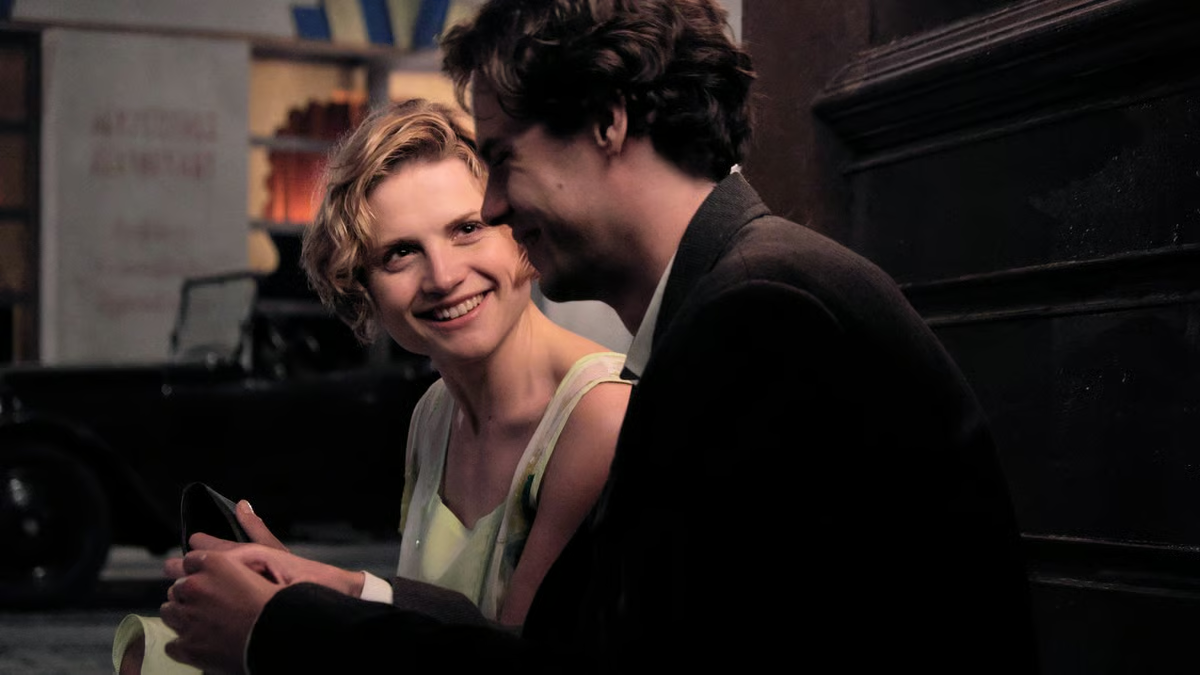
Mala Emde as Hélène, an aspiring doctor who decides to hide her Jewish identity after arriving in Weimar-era Berlin, in “Blind at Heart,” Barbara Alpert’s film adaptation of Julia Franck’s novel, “Die Mittagsfrau.”. Image: B&B
When I first started attending B&B, 2009, there were lots of films exploring the Nazi Era through historical reenactments. There’s been a big evolution from the straight Holocaust dramas towards intergenerational stories that explore trauma in much more complex and interesting plots. You screen one or two of these every year. How do you select these?
Sophoan Sorn: For me, it’s the hidden histories and vantage points that provide new views, insights into the experiences of the people who were affected during this era and various periods in history. We have the two world wars, separatist conflicts, and we have ongoing conflicts, and there are a lot war-torn stories. The movie has to really impress; the story has to deliver. For example, right now, there’s Barbara Alpert’s film “Blind at Heart,” which is more than just a Nazi story. It’s an adaptation of Julia Frank’s “Die Mittagsfrau” (“Blind at Heart”) which won the German Book Prize. It stars Mala Emde in a story that is taking place during the Nazi regime but it’s all of these experiences her character was going through that make it so moving. The Holocaust was woven in as a foreground/background thing that her character is dealing with while living her individual life.
Another example, is “The Zone of Interest,” that was a huge Cannes winner and Oscar contender from a few years ago (2023) with Christian Fridel playing the commandant of the Auschwitz concentration camp living a kind of idyllic home life with his wife and kids. Just beyond their garden wall, they could hear gunshots and screaming from the camp but went on with their lives in terrible denial. There are so many fascinating personal experiences, vantage points, and flashback stories that are impacting people later on and that are so interesting now.

Paula Beer (passenger) as Laura and Barbara Auer (foreground) as Betty in Christian Petzold’s “Miroirs No. 3.” Image: B&B
You have three films where music is integral this year—“Köln 75,” “KREATOR – Hate & Hope” and “Miroirs No. 3.” With your strong background in classical music, particularly piano, you must have some thoughts on them.
Christian Petzold’s “Miroirs 3” (2025) titled after Ravel’s “Miroirs No. 3, Une Barque sur l’Ocean” also includes Chopin’s famous “Prelude in E minor, Op. 28, No. 4 (Largo).” Paula Beer had to learn enough piano technique to mimic playing in the film and was coached by pianist Adriana von Franqué, who recorded the film’s soundtrack. How did she do? What did you think of her acting in the film in general?

Paula Beer. Image: Jens Koch
Sophoan Sorn: She definitely knows what’s she doing and pulled that off. I’ve actually known Paula Beer since her first feature film, “The Poll Diaries” (2010), where she played the role of this naive young girl who helped this wounded anarchist and, over the course of the story, evolved into a young woman. She really gets into her roles, whether she’s a traveler in “Transit,” or a mermaid in “Undene,” or this pianist who is traumatized from a car accident and trying to find her way through life in an awful situation, which is the film we’re showing this year. She’s such a strong talent, she helps you believe what she’s doing on screen. That’s what great acting is— you get into your role and people get into your role with you. She’ll be in conversation twice, at both her film screenings.
I love how she engages in a kind of dance with you, but maintains this distance, a kind of opacity, where you’re intrigued by her but are always on the outside trying to figure her out.
Sophoan Sorn: This makes me recall “Frantz” (2016), a film of hers we showed a few years ago, which I really loved. During the pandemic, in 2021, we showed “Undine” at the Vogue with her starring, along with Burhan Qurbani’s “Berlin Alexanderplatz,” a reimagining of Döblin’s novel in modern Berlin through the eyes of an undocumented African refugee.

Austrian Thomas Prenn as Paul in a scene from Michael Kofler’s “A Land Within,” set in 1961, against the backdrop of the South Tyrolean independence struggle. Image: Kinofilm
For us, the magic in B&B is being able to bring these special talents here from Germany to connect with our audience. In addition to Paula Beer, we have Mala Ende and Burhan Qurbani with us. And Thomas Prenn returns after his 2021 visit with “Great Freedom,” which was an Oscar contender. He is coming with two films this year, “Blind at Heart” and “A Land Within.” He has won two Austrian film awards. I feel these stories are elevated even further when viewers can talk with the filmmakers and ask them questions about how they brought these stories to cinematic life.
30th Anniversary Berlin & Beyond Film Festival 2026 Schedule

Thursday, March 19: The Castro Theatre, San Francisco
10:30 AM: 22 Lengths (by invitation only) 102 min. + Q&A View Trailer
3:00 PM: Bad Painter 80 min. + 2026 Lifetime Achievement Award in Acting, posthumously presented to Udo Kier –Watch Clip– Buy Tickets
6:00 PM: Köln 75 112 min.+ Opening Ceremony/ Q&A View Trailer, Buy Tickets
Friday, March 20: Vogue Theater, San Francisco
5:00 PM: I’m Not Stiller 99 min. –View Trailer, Buy Tickets
7:30 PM: Blind at Heart 136 min. + Q&A – View Trailer, Buy Tickets
Saturday, March 21: SFMOMA’s Phyllis Wattis Theater, San Francisco
10:00 AM: Red Stars Upon the Field 133 min. –View Trailer, Buy Tickets
1:00 PM: Amrum 93 min. –View Trailer, Buy Tickets
3:30 PM: KREATOR – Hate & Hope 110 min. View Trailer, Buy Tickets
6:15 PM: No Beast. So Fierce. 142 min. + Q&A View Trailer, Buy Tickets
Sunday, March 22: Rialto Cinemas® Elmwood, Berkeley
10:15 AM: Greetings from Mars 85 min. –View Trailer Buy Tickets
1:45 PM: Köln 75 112 min. + Q&A –View Trailer- Buy Tickets
4:45 PM: A Land Within 112 min. + Q&A View Trailer, Buy Tickets
Monday, March 23: Rialto Cinemas® Elmwood, Berkeley
1:45 PM: The Frog and the Water 100 min. View Trailer, Buy Tickets
4:00 PM: 22 Lengths 102 min. –View Trailer – Buy Tickets
6:45 PM: Miroirs No. 3 86 min. –View Trailer Buy Tickets

 Geneva Anderson is a free-lance writer based in rural Penngrove, CA who writes on art, film, food, identity, and cultural heritage. She is the editor of ARThound, an online arts publication. She grew up on a small farm in Petaluma, CA, with animals and gardens. A graduate of UC Berkeley, Princeton, and Columbia School of Journalism, she covered the transition of Eastern Europe from state socialism and reported for seven years from Central and Eastern Europe, the Balkans and Turkey. She has also worked on assignment in Asia, Cuba, Mexico, South America.
She has written or done photography for Art, Arte, ARTnews, The Art Newspaper, Balkan, Balkan News, Budapest Sun, EatDrinkFilms, Flash Art, Neue Bildende Kunst, Sculpture, EIU, Euromoney, The International Economy, The Press Democrat, The Argus Courier,Vanity Fair, Global Finance, and others. She is passionate about Rhodesian Ridgebacks and currently has two, Frida and Ruby Rose.