
“Artists are the gatekeepers of truth, the anchor of civilization and the compass for humanity’s conscience”
-Michelle Satter
Geneva Anderson interviewed a selection of the many filmmakers who have been through Sundance Labs to accompany her interview with Michelle Satter .
Satter will be honored with SFFILM’s 2026 Mel Novikoff Award on Thursday, April 30, at a special evening that includes Satter in conversation with award-winning Oakland filmmaker Peter Nicks, followed by a screening of Benh Zeitlin’s 2012 film “Beasts of the Southern Wild,” a wildly successful project supported by both Sundance Institute and SFFILM.
Clicking on the names in blue will take you to their filmography.
Benh Zeitlin

Creative advisor Walter Bernstein and Lucy Alibar, the “Beasts” co-writer with Benh Zeitlin at the Screenwriters Lab (2009). Photo by Jill Orschel. Photo Courtesy of Sundance.
Zeitlin developed his first feature, “Beasts of the Southern Wild” in the 2009 January Screenwriters Lab, the 2009 June Directors Lab, and the 2011 Directors and Screenwriters Labs. It went on to win the 2012 Grand Jury Prize at Sundance and was nominated for four Academy Awards.
What Michelle does at the labs is a purely egoless and generous thing which is so rare to find in the world. She’s not taking credit for other people’s work or for the incredible impact she’s had on films. The egolessness of the lab experience itself is what really makes it work and that is in the spirit and image of Michelle.
The labs provide you with specific advisors who are reading your script and who you continue to work with, but it’s Michelle who comes in when she’s needed to save the day. That definitely happened on my film. After we shot “Beasts,” the edit was really lost in post-production and we were really struggling with how to solve the movie. Michelle came in and watched all these cuts. At the time, I was editing alongside my longtime editor and best friend. Michelle could see that we were lost and couldn’t really see the film anymore because we’d been working on it for so long. I still remember that conversation today, which is very hard to have with a filmmaker, to say ‘I think you need somebody else, fresh eyes to look at this.’ She comes in and has that talk with me herself and that’s something I really appreciate about Michelle. She knows how to have hard conversations with artists when they need to be pushed to challenge themselves even more, or to do something uncomfortable or to look more deeply within themselves or to look outside themselves for help. She watches all those things from the very beginning stages of your writing process to the very completion of your film.
We brought in Alfonso Gonzales who also edits at the Sundance Lab who is part of an incredible network of like-minded filmmakers who make films for deep reasons. He was willing to come and help a first time feature filmmaker and we continue to work together to this day. Whenever I do that deep work with young filmmakers, I pass on the lessons that I learned at Sundance: helping them excavate their personal story; trying to get at why they really want to tell this story and what in them is really true that needs to be brought forward to tell the story. Those things are always at the front of my mind and how Michelle modeled that.
Read how Benh made “The Beasts of the Southern Wild.”
Ritesh Batra
 Ritesh Batra developed his project “The Story of Ram” at the 2009 Screenwriters and Directors Labs. The script earned Batra the Sundance Time Warner Storytelling Fellowship and an Annenberg Fellowship. Batra also credits his 2013 debut feature, “The Lunchbox,” to the experience he had at Sundance in 2009. The film premiered at Cannes, winning the Grand Rail d’Or, the top out of competition award for best new voices in cinema.
He was honored at the 65th San Francisco International Film Festival on April 27 with An Evening with Ritesh Batra + “The Lunchbox,” which featured Batra in conversation about the musical stage adaptation of his film at Berkeley Repertory Theater, May 17-June 28.
Michelle’s the one who opened doors for me and is a very important figure in my life. I’d do anything for her.
I actually applied to the lab three times and was lucky to get in on my third time. When you get there, you really realize how unique it is; it’s a very magical environment, such a nice energy. Michelle taught me there is a way to be a leader in a very focused and soft-spoken kind of way and how to listen and that’s her biggest gift to me. I was in film school at NYU and the impression we were given there was that directors on set have to be frantic, shouting. When I was at the lab and experienced Michelle creating a beautiful environment where everybody could thrive, where ideas flow and where people could be brave and take risks, I really took that with me. In every set I’ve been on as a director, I’ve always tried to practice that. After my lab experiences, I actually got empowered to focus on making my movie and to drop out of film school.
When I go back as an advisor, I feel like that is a healing and very special time for me, where I can reconnect with a lot of core values. There is really no other agenda there except being present for other people and receiving from other people.
Watch Ritesh Batra’s Case Study on making “The Lunch Box” on Sundance Collab.
Beth d’ Araújo

Beth with Michelle at the 2026 Sundance Film Festival where her “Josephine” was a hit. Photo Courtesy of Sundance.
Araújo developed her second feature, “Josephine,” over 12 years at Institute labs, last participating in the 2018 Screenwriters and Directors Labs. The film won both the Grand Jury Prize and Audience Award at Sundance in 2026.
“Josephine” would have never been made had it not gone through the labs program because its subject matter—rape and a child witnessing a rape—were challenging to financiers and to studios. Without some sort of stamp of prestige from Sundance and the quality of training I received there, this story would not have been told.
I remember my first morning at the screenwriter’s intensive lab where everyone was sitting around this table. “Tell us why you want to tell this story,” that’s how you introduce yourself to everyone…we’d go around the table. It was then that I realized I had never really ever discussed out loud what my personal connection to the story was, that I had witnessed a rape when I was eight years old. I burst into tears. I could not control my emotions. I don’t know what it is about Michelle but immediately she had me. I was allowed to be completely myself. The entire room was filled with love, kindness, and earnestness. And that’s the gist of the labs. Michelle just embodies this feeling of calm and openness and the spaces she creates for artists allow them to be like that too.
The decision to have to have a real person appear in the scene with Josephine, who is experiencing the perpetrator haunting her in her imagination, was something that came directly out of the Director’s Lab where we were pretty much encouraged to experiment and fail. I decided to try that and it turned out to be remarkably profound for me. Each time you screen a scene you’ve shot, you get feedback from the mentors. My group had ten people who have had very fruitful careers, including Robert Redford. They all said it was a very effective moment that reinforced how connected she still was to the memory of that experience. I decided to incorporate that into the script.
Robert Redford cared a lot and made an important observation that the child actor I was using for the scene I screened was not living in the moment. He felt like she was waiting for her next line and in between, she seemed liked she wasn’t really present. He made quite a big deal about that. I remember being mortified and embarrassed at the time. Now, I feel grateful for him taking his time to attend and to critique me, someone who was one of the best. He said she’s not living in it and you have to get her to live in the character not just be dictating these moments to her. You need to work with her on that. I went back to the drawing board and tried to come up with activities we could do to make her feel more present in her scenes that would help her feel like she was living in the character.
Read Indiewire’s report on the success of “Josephine” at Sundance (2026).
Daniel Krauss
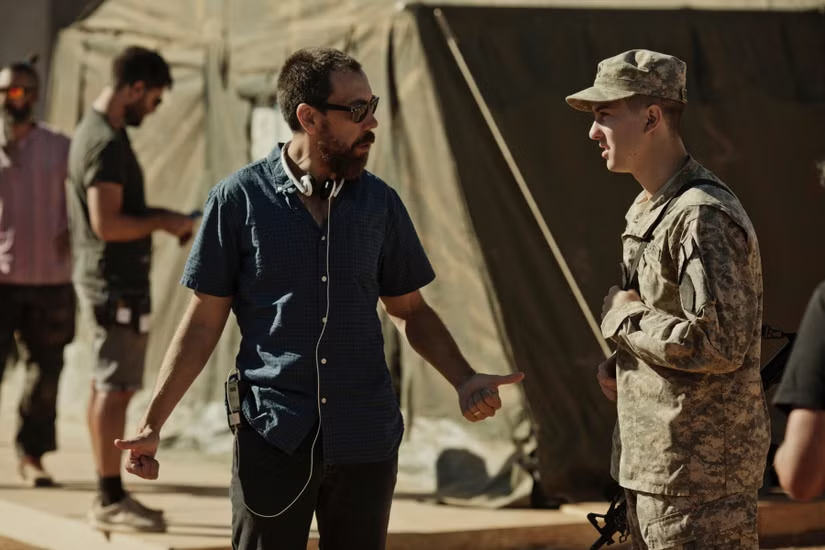
Krauss adapted his documentary “The Kill Team” (2013) into his first narrative feature in the 2015 Screenwriting Lab and Director’s Lab
I’d been at Sundance labs in 2012 for the story and edit labs for my documentary, “The Kill Team” and came back in 2015 to the Director’s Lab with a fictional screenplay based on that doc and that’s how I met Michelle. It’s been over 10 years now but I remember how generously and thoughtfully Michelle rejected my script initially. I’d applied a couple of times, and been rejected. It was incredibly disappointing but I later realized that Michelle knew precisely when the script was ready for intense workshopping. We had a conversation; it wasn’t a letter or email, but she called me and it was the most inspirational rejection I’d received because it was accompanied by this very generous and thoughtful detailed discussion around the script. I was left feeling driven to prove that I could get the script to a point where it could be in the lab. She even checked back with me which was very motivating. Failure was part of the process that led to my understanding of what it is about my script that would unlock the best story and bring the writing, the structure and characters to a point where we could actually have those vital discussions at the labs that would bring that additional layer of complexity, sophistication, and humanity that would elevate it past just being a story into art.
Part of that lab process is spending time with some of the most brilliant storyline minds spirit of generosity and kinship and support. My class alone had Boots Riley, Bart Layton, Mia Dacosta, Olivia Newman and those were just my peers. We also an incredibly gifted professional support team of mentors overseeing it.
Read Going Deeper Inside “The Kill Team.”
Peter Nicks

Oakland-based Emmy-winning documentarian Peter Nicks, joined the Sundance Institute Board in 2023 and is a member of the SFFILM committee that selected Michelle Satter for the 2026 Mel Novikoff Award. His lauded Oakland trilogy: “The Waiting Room” (2012), “The Force” (2017), and “Homeroom” (2021)) explores the interconnected narratives of health care, criminal justice and education in Oakland. His most recent doc, “Stephen Curry: Underrated,” (2023) premiered at Sundance and opened the 66th SFFILM Festival. Nicks co-founded Proximity Media with fellow Oakland-based filmmaker and Sundance Institute alum, Ryan Coogler.
I’ve never been through one of Michelle’s labs because she focuses more on the fiction side. As a board member, last summer I went to Colorado to Estes Park to observe their 14 day Directors Lab and witnessed Michelle in action. Just watching her, not so much what she said, but experiencing her demeanor, her calmness, her observational gifts. Michelle sees you and then she listens to you, operating as a quiet force that begins to reveal itself with all these filmmakers. Because she sees these filmmakers, it allows them to see themselves and that’s the power of that intense process. I don’t know if there’s anything else quite like it. It’s not college; it’s not summer camp; it’s not therapy; it’s a mixture of all those things. In some ways, she has the gifts of a therapist, of a supportive parent, and of a peer who understands how hard it is to bring an independent film to life, to feel something so strongly within you. And she has powerful connections —an entire community of filmmakers, mentors, and key industry people—built up over forty years who are there to help. Michelle is the institute’s “secret sauce;” there’s really nothing comparable.
Read Peter Nicks on “Stephen Curry: Underrated” and a Tale of Hoop Dreams.
Other Notable Filmmakers & Projects from Sundance Labs
- Gregory Nava and Anna Thomas: Participated in the 1981 Directors/Screenwriters Lab with El Norte.
- Quentin Tarantino: Participated in the 1991 Screenwriters and Directors Lab with Reservoir Dogs
- Paul Thomas Anderson: Participated in the 1993 Screenwriters and Directors Lab with Sydney (later Hard Eight).
- Cary Fukunaga: Participated in the 2006 Screenwriters and Directors Lab with Sin Nombre.
- Dee Rees: Participated in the 2007 Screenwriters and 2008 Directors Lab with Pariah
- Ryan Coogler: Participated in the 2012 Screenwriters Lab with Fruitvale Station
- Chloé Zhao: Participated in the 2012 Screenwriters and Directors Lab with Songs My Brother Taught Me
- Marielle Heller: Participated in the 2012 Screenwriters and Directors Lab with Diary of a Teenage Girl
- Damien Chazelle: Developed Whiplash with Sundance Institute support in 2013
- Daniel Kwan & Daniel Scheinert (The Daniels): Participated in the 2014 Screenwriters and Directors Lab with Swiss Army Man
- Robert Eggers: Participated in the 2014 Screenwriters Lab with The Witch
- Boots Riley: Participated in the 2015 Screenwriters and Directors Lab with Sorry to Bother You
- Nia DaCosta: Participated in the Screenwriters and Directors Lab with Little Woods
- Barry Jenkins: Participated in the Episodic Lab
- Lulu Wang: Participated in the Film Two Initiative with The Farewell.
- Sean Wang: Participated in the 2024 Screenwriters and Directors Lab with Didi
Other Prominent Alumni
- A.V. Rockwell
- Andrea Arnold
- Bart Layton
- Bill Wheeler
- Charlotte Wells
- Darren Aronofsky
- Gina Prince-Bythewood
- Gregg Araki
- Ira Sachs
- James Mangold
- John Cameron Mitchell
- Lisa Cholodenko
- Nicole Holofcener
- Rick Famuyiwa
- Sterlin Harjo
- Taika Waititi
- Walter Salles
View a Timeline of the Sundance Institute here.
Visit the Sundance Institute website for information about all their programs and the next Sundance Film Festival as it moves to Boulder, Colorado.


 Geneva Anderson is a free-lance writer based in rural Penngrove, CA who writes on art, film, food, identity, and cultural heritage. She is the editor of ARThound, an online arts publication. She grew up on a small farm in Petaluma, CA, with animals and gardens. A graduate of UC Berkeley, Princeton, and Columbia School of Journalism, she covered the transition of Eastern Europe from state socialism and reported for seven years from Central and Eastern Europe, the Balkans and Turkey. She has also worked on assignment in Asia, Cuba, Mexico, South America.
She has written or done photography for Art, Arte, ARTnews, The Art Newspaper, Balkan, Balkan News, Budapest Sun, EatDrinkFilms, Flash Art, Neue Bildende Kunst, Sculpture, EIU, Euromoney, The International Economy, The Press Democrat, The Argus Courier,Vanity Fair, Global Finance, and others. She is passionate about Rhodesian Ridgebacks and currently has two, Frida and Ruby Rose.