
By Noma Faingold. (October 2, 2026)
Award-winning actress/singer Bea Arthur, best known for culture-shifting characters in sitcoms, “The Golden Girls” and “Maude,” rarely gave interviews. She preferred to keep her life private. She never went into show business seeking fame. She spent decades in live theater before landing “Maude” at age 49.
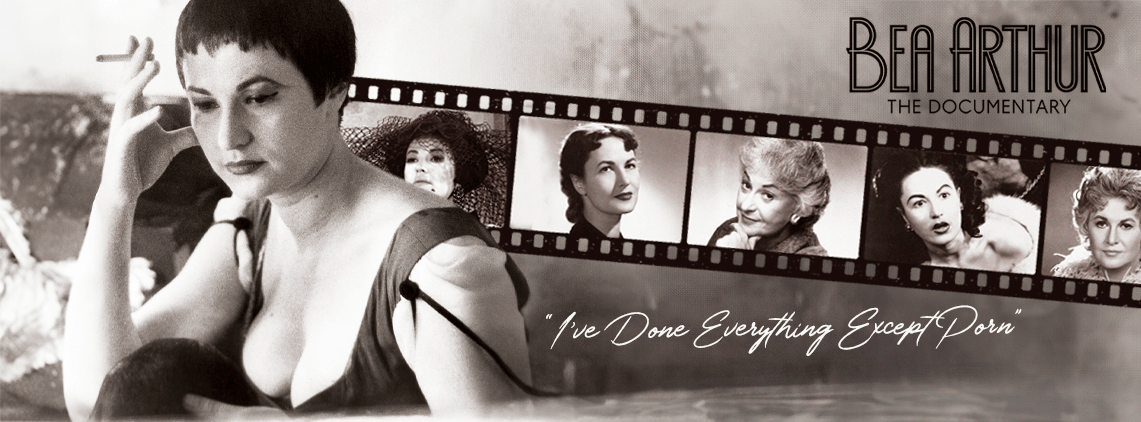 Arthur trusted director/producer Dan Watt, who was also Arthur’s personal assistant from 2004 until her death in 2009, to tell her story. An intimate, 90-minute lunchtime interview became the catalyst for the new feature film, “Bea Arthur: The Documentary – I’ve Done Everything Except Porn.”
It is being screened at the at the Orinda Theatre, October 10 and 11 and at San Francisco’s Balboa Theater on October 12. The world premiere is at the Palm Springs Cultural Arts Center on October 3. And then it will have a wider national release.
As the doc begins. Watt and Arthur are sitting at the kitchen table of Arthur’s longtime Brentwood home. He asks her how she wants to be remembered. “As an artist, an important artist,” she said. “The important thing is getting in front of an audience.”

Bea with director Dan Watt.
After Arthur passed at age 86 (due to complications from lung cancer), the treasured, in-depth interview recording sat in a lock box for 20 years. Watt wasn’t sure how he wanted to present Arthur’s life until three years ago.
During the five years he worked for her, they became close friends. He organized her papers, scripts, managed her fan mail, coordinated logistics and repeatedly loaded her fax machine. They cooked for each other. They cooked together. They laughed a lot.
She read the New York Times and the Los Angeles Times cover to cover and watched CNN for three hours every morning. Once Watt arrived, she eagerly wanted to discuss the news of the day. “That’s what I miss the most,” he said.
“Bea didn’t like talking about herself. She didn’t trust many people. She granted me permission,” Watt said. “This documentary had to be just right or not put it out there. I had to respect her as a human being and as a friend.”
When Watt rewatched the never-before-publicly-seen interview, he told himself, “I had this gem. Why don’t I see if I can make her wishes come true?”
 Watt, who lives in Torrance, California, was still working at Columbia Pictures in the development department after Arthur hired him. Mostly, he visited Arthur on weekends – whichever day her grandchildren weren’t swimming in the pool. “Everything revolved around her two sons and grandkids,” Watt said. “She separated family and show business and she lived her life that way.”
In the film, Watt dives deep into her many years on Broadway, Off-Broadway (musicals, comedy and drama), summer stock and cabaret, highlighting her Tony-winning role in 1966 playing Vera Charles in the musical “Mame,” starring Angela Lansbury. The two performers remained close friends for the rest of their lives. At the time, Arthur was married to the director of “Mame,” Gene Saks, her second husband (from 1950 to 1978).
Her recollections are paired with fresh interviews from colleagues, collaborators and friends, including Broadway star Chita Rivera, “Fiddler on the Roof” lyricist Sheldon Harnick (Arthur originated the role of Yente the Matchmaker in 1964), comedy writer Bruce Vilanch and comedian/actress Rosie O’Donnell.
Watt is currently collaborating on an untitled documentary with O’Donnell, which focuses on children with autism. One of her children is autistic. She will no doubt find the humor in raising Clay, as she did in her recent one-woman show, “Common Knowledge,” in New York over the summer.
Deep-voiced actress Arthur developed her sharp comedic timing and imposing characters of left-leaning Maude Findlay on “Maude,” (1972-1978), a spinoff of Norman Lear’s “All in the Family” and deadpan Dorothy Zbornak in the beloved, “The Golden Girls” (1985-1992). She won an Emmy for each role.

“The Golden Girls”(From left) Rue McClanahan, Estelle Getty, Bea Arthur, and Betty White holding Emmy Awards for the TV series The Golden Girls. The series received 68 Emmy nominations and 11 Emmy Awards, and all four lead actresses won Emmys for their performances on the show.
In the documentary, actress/comedian O’Donnell describes Arthur as a “precision assassin,” when it came to comedy.
Arthur studied at the New School of Drama in New York and took her craft very seriously. According to Watt, a pivotal time in her career came when she got laughs playing Lucy Brown in a 1954 production of “The Threepenny Opera.” “That’s when she knew she had something to give,” he said.
Watt, who started out as a dancer, came to the realization early in his career that he needed to be a triple threat to make it in live theater. “I couldn’t sing,” he said. So, he pivoted to choreography. He went on to produce and choreograph more than 20 stage musicals and gala fundraisers in the Los Angeles area.
He met Arthur at a fundraiser for a non-profit he started, Art Attack Foundation, dedicated to supporting and nurturing young talent in the performing arts. She was impressed with the way Watt ran the event and asked him to work for her. He was kind of shocked but agreed to show up the following Saturday at her home. He said to his husband that night, “What the f*ck just happened? I think I’m working for Bea Arthur.”
While at Columbia Pictures, Watt was part of the film development team that produced “House Bunny,” with Anna Farris and “Just Go with It,” co-starring Jennifer Aniston and Adam Sandler. He also had worked for Simon Cowell for five years, concentrating on the production of the documentary, “This Is Us,” about One Direction’s pop takeover of the U.S. It was directed by the late Morgan Spurlock, who became a mentor and friend to Watt.
Wanting to tell stories, Watt formed DancinDan Productions. Arthur called him “Dancin” because one of her two sons had the name Dan. He grew up being mesmerized by the pioneering, issue-focused “The Phil Donahue Show,” and later, “The Oprah Winfrey Show.” Watt’s mother didn’t understand why he didn’t want to play outside, like the other kids in the neighborhood. Simple. He was drawn to the conversational format of talk shows.
Watt directed and his company produced “Bea Arthur: The Documentary,” along with Tony winner Daryl Roth. Two things about Arthur that Watt had to include in the film: her longtime advocacy for the LGBTQ+ community and the fact that she never really stopped working, whether it was guest spots on “Malcolm in the Middle,” “Curb Your Enthusiasm” or her one-woman show, “Bea Arthur on Broadway: Just Between Friends,” which she performed intermittently from 2002 to 2004 in New York, Los Angeles and other cities.
In the show, filled with amusing showbiz anecdotes and clever numbers, she performed barefoot in glittery cardigans and dress pants. She wanted to look glamorous and still be comfortable. She stuck to the script, but you’d never know it because of the show’s breezy flow and her trademark pre-punchline pauses, combined with her signature stare.
Arthur’s activism was consistent, although she would never call it activism because she didn’t see herself as being on the front lines. “She did her stuff quietly behind the scenes,” Watt said.
She made significant contributions and shared her talent with many organizations, including GLAAD, Broadway Cares and amfAR, as well as lesser-known organizations like the Ali Forney Center in New York, a non-profit with the mission of saving the lives of LGBTQ+ and at-risk youth.

A publicity photo taken about 1973. Courtesy of CBS
Perhaps growing up in Cambridge, Massachusetts, in one of the few Jewish families (born Bernice Frankel) in the 1920s and 1930s, Arthur could empathize being an outsider. The LGBTQ+ community noticed the way her formidable characters on television didn’t take crap from anyone and stood up for marginalized communities. “Most of her friends were gay. Her love of the gay community was mutual,” Watt said. “She would not be happy right now (with the current anti-LGBTQ+ legislation and rhetoric).”
Watt is carrying on Arthur’s altruistic legacy by donating to non-profit organizations in each of the nine cities where the documentary will be screened. In San Francisco, The Lyric Center for LGBTQQ+ (which supports lesbian, gay, bisexual, transgender, queer and questioning youth, their families and allies) will benefit.
“Bea Arthur: The Documentary – I’ve Done Everything Except Porn,” directed and produced by Dan Watt, will screen at the Orinda Theatre on October 10 at 6:30 p.m. and October 11 at 1:15 p.m. https://www.orindamovies.com
The film will also be shown at San Francisco’s Balboa Theater, 3630 Balboa St., October 12 at 7:30 p.m. https://www.balboamovies.com
There will be a Q&A with Watt after each screening.
For a list of other showing and more info on the film go to the website. https://www.beaarthurdocumentary.com/about 
Noma Faingold is a writer and photographer who lives in Noe Valley. A native San Franciscan who grew up in the Sunset District, Faingold is a frequent contributor to the Richmond Review and Sunset Beacon newspapers, among others. She is obsessed with pop culture and the arts, especially film, theater and fashion. Noma has written about poet Lawrence Ferlinghetti, artists Tamara de Łempicka, Isaac Julien, and Wayne Thiebaud, numerous independent filmmakers, and singer/songwriters Janis Joplin, Diane Warren, and Linda Smith for EatDrinkFilms.