
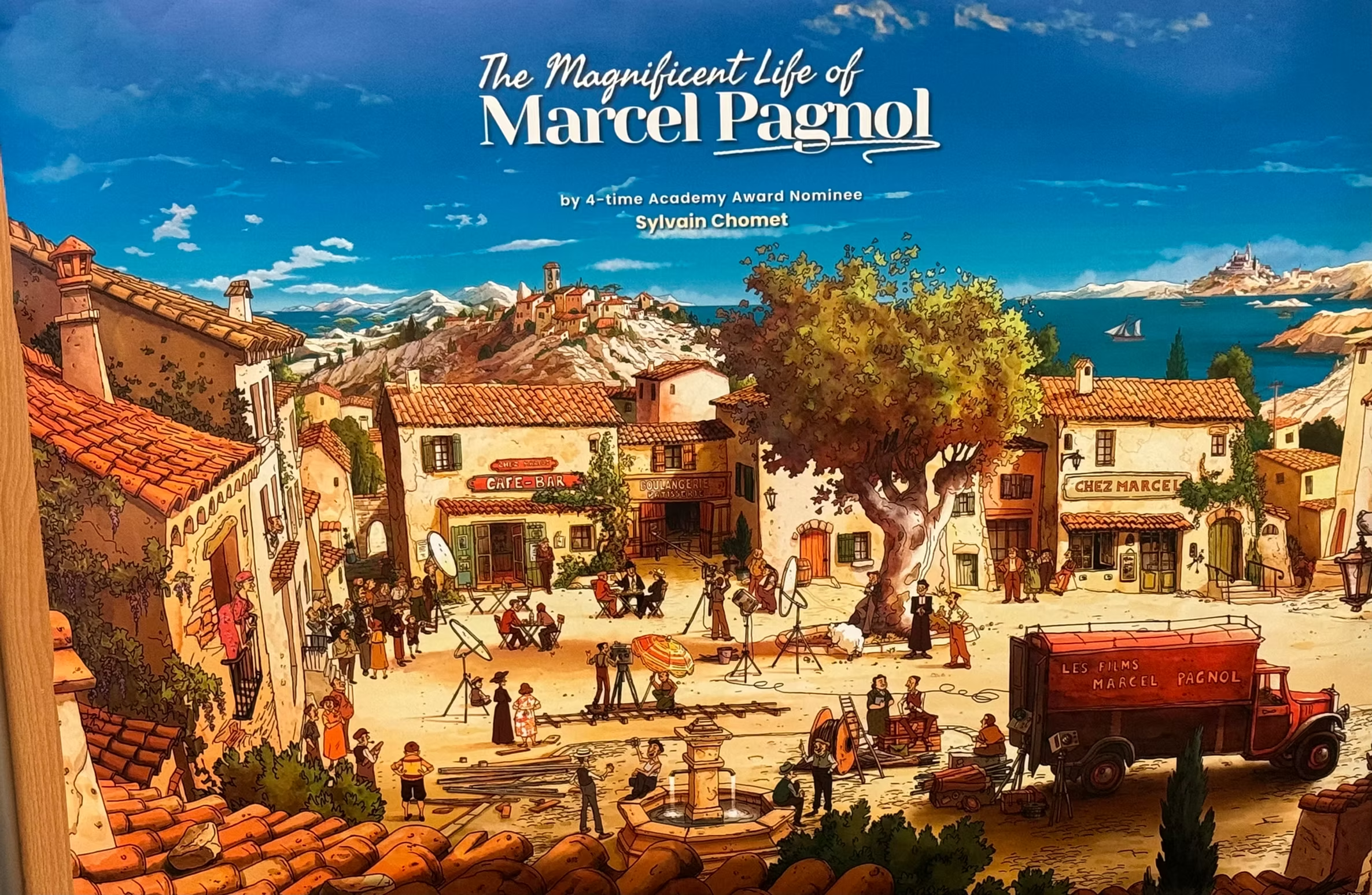
The new feature film A Magnificent Life is an animated biography of the great French novelist, playwright, and filmmaker Marcel Pagnol. His first successes on film were “The Marseille Trilogy” composed of Marius, Fanny, and César. He continued making movies, adapting some for stage and writing numerous books that have also been adapted to screen by others such as the popular Manon of the Springs, Jean de Florette, My Father’s Glory, and My Mother’s Castle.starring many of the best actors in French cinema.

The official Marcel Pagnol Website is a great place to learn more. If you have been to Alice Waters’ Chez Panisse in Berkeley you will have seen many posters for the films. The popular restaurant is named after Honoré Panisse, a character in the Trilogy. Waters wrote, “Every one of the Pagnol movies about life in the south of France fifty years ago radiated wit, love for people, and respect for the earth. Every movie made me cry. We named the restaurant to evoke the sunny good feelings of another world that contained so much that was incomplete or missing in our own—the simple wholesome good food of Provence, the atmosphere of tolerant camaraderie and great lifelong friendships, and a respect for both the old folks and their pleasures and for the young and their passions.”
We have asked animation historian, author and teacher Karl Cohen and the award-winning animator Steve Segal to review A Magnificent Life, opening in many theaters on March 27.
The films official website.
|
When I read that A Magnificent Life by Sylvan Chomet was opening in San Francisco, I anticipated reviewing a remarkable film. Chomet had directed the delightful surreal fantasy The Triplets of Bellville, (2003. 2 Oscar nominations), one of my favorite films. Instead of it being a wonderful lighthearted comedy, it turned out to be a most unusual film experience, unlike any other. Read the full review below |

Reviewed by Steve Segal Sylvain Chomet has yet to fulfill the promise heralded by his brilliant debut feature, The Triplets of Belleville. His new feature, A Magnificent Life, for all its charms, is ultimately unengaging. This film proves it’s difficult to distill a creative genius’s life into 90 minutes. Read the full review following Karl Cohen’s review followed by director interviews and Pagnol posters. |


DISCOVER WHO MARCEL PAGNOL WAS IN CHOMET’S A WONDERFUL LIFE.
Reviewed by Karl Cohen

When I read that A Magnificent Life by Sylvan Chomet was opening in San Francisco, I anticipated reviewing a remarkable film. Chomet had directed the delightful surreal fantasy The Triplets of Bellville, (2003. 2 Oscar nominations), one of my favorite films. Instead of it being a wonderful lighthearted comedy, it turned out to be a most unusual film experience, unlike any other.
A Magnificent Life is a loving biography of Marcel Pagnol (1895 – 1974), a novelist and playwright who became France’s greatest film producer and studio head before WWII. The film is constructed around the aging producer recalling moments in his life for a series of magazine articles.
What sets it apart from the films we are used to seeing is how Chomet experimented with his visual techniques. He chooses to present his film with two distinct visual approaches, ones that he felt were appropriate for the periods the action was taking place. The film starts with a simplified idea of visualizations from the age of live theatre before talking pictures were invented. Then, when Pagnol becomes involved with cinema at the beginning of sound movies, his visuals are influenced by the look of early talkies.
Before Pagnol starts his film career, everything is taking place on a proscenium stage and we are sitting in the audience. To make this part of the movie look even more archaic, the camera is locked down on a tripod. There are no pans, zooms or moving the camera to a different position including not cutting to closeups. Since you and I are used to the contemporary taste for fast cutting and action in movies, his archaic look will probably leave you feeling that some scenes are too long and dull.
With the coming of talkies Pagnol was invited by Paramount France to adapt his recently produced successful stage plays to the movies. Now he is a filmmaker learning to use cuts, camera movement and other techniques and Paramount is financing an ambitious slate of movies, The Marseille Trilogy: Marius 1931’ Fanny, 1932 and Cesar, 1935.
Chomet doesn’t recreate sequences from the films. Instead, we learn about how he was invited to become a filmmaker and the tremendous success of the trilogy. We get very little information about their content and we don’t see Pagnol working with his actors and others on sound stages. Instead, the film goes on to discuss other milestones in his career.
One fascinating segment of the film for me was learning about Pagnol having to work in France during the Nazi occupation. It wasn’t easy and he even chose to destroy a finished film he was proud of, rather than letting the fascists get a hold of it.
Chomet’s depiction of Pagnol in A Magnificent Life is not what you might expect. Rather than showing him as an extroverted producer proud of his every accomplishment, we see him on several occasions pondering his work with his face buried in his hands. Perhaps he is thinking about how he could have made a sequence better. ![A Magnificent Life [Sony Pictures Classics]](https://i0.wp.com/www.animationmagazine.net/wordpress/wp-content/uploads/A-Magnificent-Life-editing.jpg?resize=670%2C335&ssl=1)
We learn that as a child he often sought approval of his actions from his father.

A Magnificent Life is an unusual film experience in several ways that challenge the viewer. It isn’t a nice free flowing story, but a series of important moments that one person experienced in their life. Chomet gives us the pieces and lets us put them together for ourselves io decide if Pagnol did in fact live a magnificent life.
Today most people in the US are not familiar with Pagnol or his celebrated film career that included over 20 features. Most of us were not alive when his last film was released in 1954. I was barely aware of his work as my parents talked about his trilogy and had me see one of his films when I was quite young.
Although a perfectly good biography could have been made using live actors and film clips, Chomet made his tribute to Pagnol using his exquisite animation skills. His work is exceptional, even his fascinating colorful expressive faces. Their bodies are realistically rendered, but the faces are wonderfully drawn 2D caricatures with delightful exaggerated features.
The extremely handsome sets are also quite appealing. They are masterfully painted with lots of details. A lot of research must have gone into illustrating the period rooms and their content.
A Magnificent Life by Sylvan Chomet is a work for serious film lovers who want to explore unusual approaches to animation. It isn’t a movie to see if you are going with friends for a fun night at the movies. It isn’t anything like the joyful Triplets of Bellville. Instead, it is an educational experience, a serious introduction to the career of Marcel Pagnol.


Animation producer Marcy Page and animation teacher Diana Morse present Cohen a lifetime ASIFA Award, usually reserved for directors, at the Ottawa Animation Festival, 2008. photo courtesy: K. Cohen
Karl Cohen has been teaching animation history at San Francisco State University since 1993, and has been writing about it since the late 1970s. A notable collector of animated films, he is the author of Forbidden Animation: Censored Cartoons and Blacklisted Animators in America. As the president of ASIFA/San Francisco, he edits and writes for the ASIFA/San Francisco newsletter, read by animation fans around the world. He is currently writing a book on animated propaganda,and has written for EatDrinkFilms.com about Pixar, surrealism, classic Disney animators Marc Davis, and Charley Bowers. Karl has compiled and presented dozens of programs of animated and live action shorts including “Surrealism in Animation.”
Read the cineSOURCE Magazine in-depth interview with Cohen.
A Less Than Magnificent Life
Reviewed by Steve Segal
 Steve Segal ran a studio in Richmond, Virginia in the 1970s making commercials and educational films. He also created several independent short films which have won awards at film festivals and been included in theatrical packages. Steve has been teaching animation for over 40 years. In 1986 he used an early computer program to plan scenes for the animated featureThe Brave Little Toaster. He worked as an animator on PeeWee’s Playhouse and made an animated musical film for Sesame Street. At Pixar he animated on the feature films Toy Story and A Bug’s Life, the theme park attraction It’s Tough to be a Bug, and the Oscar winning short film Geri’s Game. He has previously written for EatDrinkFilms.
Visit Steve’s Website at Segaltoons.com
Follow him on Facebook.
All Photos courtesy from A Magnificent Life © 2025 What the Prod – Mediawan Kids & Family Cinéma – Bidibul Productions – Walking the Dog. Courtesy of Sony Pictures Classics.
Ramin Zahed interviews Sylvain Chomet for Animation Magazine.

Jordan Raup interviews Chomet for The Film Stage.
The movie posters for the films of Marcel Pagnol were often quite playful. He most frequently collaborated with Albert Dubot who died 50 years ago in 1976. There has been considerable press coverage in France this year and an Internet search will provide many articles and images like this one. The Dubot website.
 Look here for many more posters .
Plus a new set created for an anniversary reissue in France.
