
By Noma Faingold
“Each of my paintings is a self-portrait.”
Tamara de Łempicka, artist

Group of Four Nudes (1925). © 2023 Tamara de Łempicka Estate, LLC
Julie Rubio first came face-to-face with Tamara de Łempicka’s seductive art at a hotel in Miami many years ago, when she was 21. “I’m sure they were copies, but I was drawn into the way she depicts women in her nudes,” Rubio said. “At first, the eyes seemed distant and then I connected to them.”
Thus began a decades-long fascination with the Russia-born artist, that eventually led to writing, producing and directing the documentary, “The True Story of Tamara de Łempicka and the Art of Survival,” had its world premiere at the Mill Valley Film Festival with two sold out screenings in October, 2024.

Julie Rubio, director:producer:writer at the Art Deco Redwood Room in the Clift Hotel. Photo by Noma Faingold
Coincidentally, the first retrospective exhibit in the United States of Łempicka(1894-1980) opened at San Francisco’s de Young Museum on October 12 and runs through February 9, 2025. The exhibition then travels to the Museum of Fine Arts in Houston, March 9 through May, 2025

Young Woman in Green, Young Woman with Gloves) (detail), 1930–1931. © 2023 Tamara de Łempicka Estate, LLC
The elegant, yet provocative paintings and drawings, synonymous with Art Deco design/era, were so impactful to Rubio, who was born in Los Angeles and has lived in Orinda for 25 years, that she discovered, like Łempicka, she was bisexual.
“Whether you identify as gay, straight, bi, or otherwise, love transcends labels. As a bisexual woman, I believe it’s natural to experience love and attraction, regardless of gender. I’ve been happily married to a man for over 18 years, but for me, love is love in all its beautiful forms,” Rubio shared.
Rubio actually started writing a narrative script 20 years ago, after meeting several of Łempicka’s family members at San Francisco’s Weinstein Gallery. They wanted a woman director to tell the story and soon Rubio was developing the project with granddaughter Victoria de Łempicka and great granddaughters Cristina and Marisa de Łempicka.
Cut to: Several years later, during lockdown of the Covid pandemic. Financing a period film with an unproven female director, who is best known for producing the 2014 feature film, “East Side Sushi,” was not happening. Rubio proposed pivoting to a documentary.
Raising funds was still a challenge. Being on the board of the San Francisco non-profit Women in Film, Rubio, now the board president, received a lot of support from the local organization. To help keep production costs down, her husband, Blake Wellen, became a co-producer. Her 28-year-old son, Elijah Stavena, was an additional editor and associate producer on the film. “Elijah’s worked on all my films,” Rubio said.
While developing and filming the doc for the last four and a half years, Rubio found that she related to Łempicka for other reasons, specifically growing up biracial, her father being Mexican and her mother white. Because Łempicka witnessed widespread anti-Semitism in Europe from World War I through the rise of Nazism, she hid her Jewish identity, even during the anything goes, roaring ’20s in Paris, where she was open about her sexuality, yet she “passed” as Catholic. Łempicka spoke French to further assimilate. She led a decadent lifestyle during those years, threw lavish parties and her sophisticated art was celebrated.
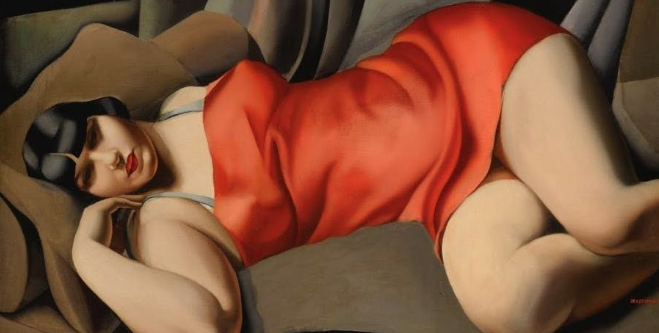
Pink Tunic (1927) © 2023 Tamara de Łempicka Estate, LLC
Rubio experienced prejudice growing up in Southern California. “I understood where Tamara was coming from. I heard racial slurs,” she said. “I was raised to not be proud of being Mexican. We were told to check the ‘white’ box. I knew what it was like to hide who I am. I decided that I was always going to lead with, ‘I’m Mexican.’”
Through her exhaustive research, Rubio was able to obtain Łempicka’s real birth records in Russia, which revealed her actual birth name (Tamara Rosa Hurwitz, replacing previously being known as Tamara Rosalia Gurwik-Górska), date (it was thought she was born in 1898) and the fact that her grandparents were buried in a Jewish cemetery.
It was a revelation to the members of the Łempicka family, several of whom are featured in the film, along with never-before-seen home movies. Rubio also shared her findings with co-curators of the Łempicka exhibit, Furio Rinaldi, Curator in Charge of the Achenbach Foundation for Graphic Arts at the Fine Arts Museums of San Francisco and Gioia Mori, author, art history professor in Italy and leading Łempicka scholar.

Painting the portrait of Tadeusz Łempicki(1928)
The film aims to show what is behind Łempicka’s paintings. At certain periods, she lived a glamorous, privileged life, like when she was married to her first husband, Tadeusz Łempicki, until they had to flee Russia almost overnight in 1917 (during the Russian Revolution) for Paris. “She was really giving the world a message through her paintings,” Rubio said.
Paris was amazing until it was obvious the Nazis would invade France. In 1939, Łempicka and her second husband, Baron Raoul Kuffner, who was 17 years older and Jewish, discreetly sold their property and art, moving to the U.S. The couple, both bisexual, had an open marriage. But they were best friends. Łempicka’s lovers were often models and muses and depicted in erotic poses. “She found beauty in everything and everyone,” Rubio said. “I love that she painted women who were shapely. She saw people for the beauty that we all have within us.”

In the U.S., Łempicka first lived in Beverly Hills and then moved to New York. At that time, her paintings, which combined Cubism, Russian avant-garde, surrealism and 18th century Neoclassic styles, were not on trend. But she kept painting and experimented a bit. After her husband died, she moved to Houston in 1963, where her daughter, Marie-Christine “Kizette” Łempicka lived. For several years Kizette was her mother’s personal secretary. Łempicka’s last residence was at a serene property in Cuernavaca, Mexico, until she passed in her sleep in 1980, surrounded by family.
While filming in 2022, Rubio lost her mother, Elizabeth Anne Rubio, and her best friend, Wendy Alice Yorke Schroeder, within a month of each other. How Łempicka survived unrest and how she kept reinventing herself was an inspiration to Rubio to keep going. “In times of darkness, she was able to find the light and she kept creating,” Rubio said. “Like Łempicka, I can take something dark, go toward the light and make something beautiful.”
Łempicka’s most revered work today, in both the art market and in popular culture, is her sleek, theatrical portraits and female nudes, which still look modern. “She saw what women could be in the future. Her art speaks to the future,” Rubio said. “She had an imagination of what could be, not just for herself, but for all women.”
Collectors include Madonna and Barbra Streisand. At auction, Łempicka’s paintings have sold for $17 to $21 million in the last few years, third highest among female artists. There has been a new recognition of her polished style. A Broadway musical, “Łempicka,” had a run last spring.
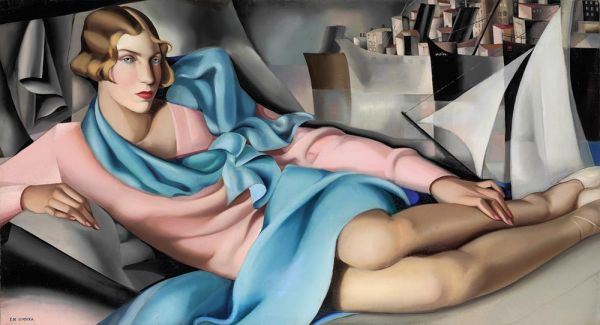
“Portrait of Arlette Boucard”, 1928
Łempicka developed an alluring public persona and knew how to market herself, which was unusual among artists of her era. “She was entrepreneurial. She understood branding before it was a thing,” Rubio said. “If she was in her prime today, she would have millions of followers on social media. There would be products.”
Rubio doesn’t rule out involvement in a Łempicka narrative feature film project in the future. She has even thought about dream casting either Lady Gaga or Scarlett Johansson. “It’s being shopped around,” Rubio said. “Maybe I can get my hands in that.”
The de Young exhibition features 60 paintings and 40 drawings, as well as a selection of Art Deco objects, sculptures and dresses from the Fine Arts Museums of San Francisco (FAMSF) collection that provide perspective on the artist’s process and historical context. It’s organized in four chronological sections.

Autoportrait (Tamara in a Green Bugatti) (1928) © 2023 Tamara de Łempicka Estate, LLC
One centerpiece is the 1928 self-portrait, “Autoportrait (Tamara in a Green Bugatti).” The iconic painting, commissioned for a cover of the German fashion magazine, Die Dame, epitomizes an independent, stylish woman in charge of her own destiny. “The toughness of the steel car contrasts with Łempicka, super soft and beautiful, behind the wheel,” Rubio said. “She can show you both sides of something. You don’t know what’s coming at you, but it’s coming 100 miles an hour. And poof! You’ve been Tamarized.”
Rinaldi, who spent three years researching and putting the “Tamara de Łempicka” exhibit together, anticipates visitors will see “her ambition, glamour and incredible talent. She’s not in the shadow of anyone. She was alone in her own greatness,” he said.
“The True Story of Tamara de Łempicka and the Art of Survival,” world premieres at the Mill Valley Film Festival. Two screenings: October 11, 7 p.m. at Sequoia 2 and October 13, 2 p.m. at The Lark Theater. Expected guests: Director Julie Rubio, Marisa de Łempicka, Victoria de Łempicka and others.
 “The True Story of Tamara de Łempicka and the Art of Survival,” will have more screenings in 2025.
“Tamara de Łempicka,” the first U.S. retrospective of the artist, opens October 12 through February 9, at the de Young Museum, Golden Gate Park, 50 Hagiwara Tea Garden Drive. Exhibit Website
There is a catalog with a preface by Barbra Streisand.
Also read Geneva Anderson’s “The Secrets of Tamara de Łempicka”
The Official Tamara de Łempicka Estate website.
Tamara de Łempicka: Dandy/Lesbian/Femininities/Art explores Lempicka’s influences with many rare photos.
Explore Tamara’s Art- The Complete Works and more
Marisa de Łempicka, daughter of the author and great-granddaughter of the subject, discusses Passion by Design: the classic biography of Tamara de Łempicka, the film’s director, Julio Rubio.
“Roxana Velásquez, Executive Director & CEO of the San Diego Museum of Art joined the pre-Broadway production cast at the La Jolla Playhouse of ŁEMPICKA during rehearsal to share highlights of Łempicka’s life and give a sense of her essence and energy.”
Tim Sika Reviews “The True Story of Tamara de Łempicka and the Art of Survival,” (start at 20:40)

 Julie Rubio is an award-winning film producer, writer, director, and actor. She is the President of Women in Film SF Bay Area. Rubio launched East Meets West Productions in 2002 and her films have been featured in many domestic and international festivals.
Rubio produced the multiple award-winning feature film “East Side Sushi,” winning awards at 16 film festivals, and receiving a nomination for Cinema Tropical’s 2016 Best Latino Film of the Year and a nomination for Mexico’s Diosa De Plata award for Best Picture.
Rubio wrote, directed, and produced the feature film “Too Perfect” and “Six Sex Scenes and a Murder.”
Other films Rubio produced include Soledad is “Gone Forever for Haiku Films,” “Oakland B Mine.” “Del Cielo (Of Heaven),” and “Everything is Temporary,” as well as music videos for the rapper Kahleo.

Noma Faingold is a writer and photographer who lives in Noe Valley. A native San Franciscan who grew up in the Sunset District, Faingold is a frequent contributor to the Richmond Review and Sunset Beacon newspapers, among others. She is obsessed with pop culture and the arts, especially film, theater and fashion and has written about singer/songwriters Janis Joplin, Diane Warren and Linda Smith for EatDrinkFilms.
 eatdrinkfilms.com