
by Meredith Brody
(September 24, 2024)
I’ve never met a film festival I didn’t like, starting with the influential and eccentric Filmex, where I worked for the late, great Gary Essert and Gary Abrahams when I was still in college.
I have heard (mild) horror stories from other people about film festivals that had projection problems and cancellations and other such glitches. The Toronto International Film Festival is the opposite of that.
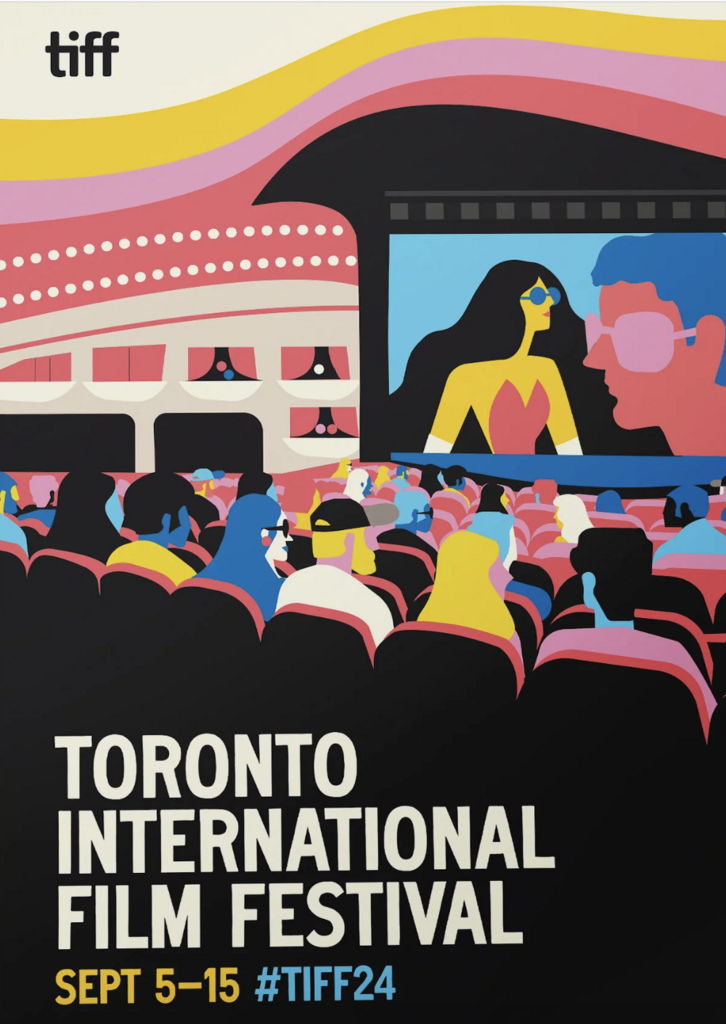
But first my favorite anecdote came from William Goldman’s book Hype and Glory, which detailed the year that he served as a judge for both the Cannes Film Festival and the Miss America pageant. As a juror, he had a special pass that allowed him to go directly to the box reserved for the Festival Jury. He arrived a little late for a screening and saw that the guard was already engaged in an argument with a couple who seemed determined to get into the theater. But the guard was even more determined that they wouldn’t. Goldman decided to wait until the rather heated discussion ended.
When it did, Goldman approached the guard and showed him his pass.
Whereupon the guard spat full in his face.
I thought “Jeez, if that happens to a famous member of the jury, what are the chances that I’LL have a good time?”
And as it happened I never worked for a publication that could afford to send me to Cannes. (Similarly, in my slightly more stellar career as a food writer, I never worked for an outlet where my expense account encouraged me learning much about wine.)
But I had the very good fortune of being invited to attend the Toronto International Film Festival fairly early on – either its 9th or 10th iteration, when it was still known as the Festival of Festivals, which lasted from 1976 through 1994. Its stated purpose then was to show the best movies from other worldwide film festivals. As its brief changed over the years, and the festival began to accept submissions and feature film premieres in addition to previously screened films, it changed its name to the Toronto International Film Festival in 1995.
I had heard wonderful things about Toronto from film critic Jonathan Rosenbaum, who I had met when we were both living in Paris and frequenting the Cinémathèque française (then at the Palais de Chaillot, with Henri Langlois still much in evidence). He dazzled me with tales of seeing every art movie from around the world at Toronto, and meeting their directors in intimacy.
But it was only after I met the wonderful and prolific Martin Knelman, film critic and writer for almost every Canadian publication, including The Globe and Mail, The Toronto Star, and the weekly arts magazine Saturday Night, as well as books on Canadian film and actors John Candy, Jim Carrey, and Mike Myers, that attending Toronto became reality. We had a mutual friend in Pauline Kael. And after meeting each other in both LA and NY, somehow not only did an invitation from the Festival materialize, but Martin and his family offered to put me up, and put up with me. Which positively thrilled the outlets I wrote for.
My first visit to the Festival was when it was still in Yorkville, a then-chic shopping district just a couple of blocks above the main drag of Bloor (also the location of the east-west line of the dead-simple Toronto Subway system). In those days your press pass not only got you into public screenings first (!), but there were scarcely any press screenings. Toronto audiences were already famed for their enthusiasm. I was seeing 4 to 6 movies a day, and I remember wandering the streets in a happy daze. I was blissed out.

Over the years – oh my, forty at latest count – I have attended TIFF from three different cities: Los Angeles, NY, and the San Francisco Bay Area. I have written about it for publications ranging from the Los Angeles and Chicago Readers to the Village Voice and too many online sites to name. I was introduced and/or educated on Bollywood films, Hong Kong action movies, the new Korean cinema, the last gasps of the New Wave (every Godard film, every Rohmer, many Chabrols, most Rivette), the new Romanian cinema, and watched as new directors appeared with their first films and then either disappeared or showed up year-after-year until they went from rubrics such as Discoveries through Contemporary World Cinema and ended up as Masters. One of the smartest thing TIFF ever did was lose the separate category devoted to Canadian film and integrate them into Contemporary World Cinema. I think it changed the world’s view of Canadian films for the better.
TIFF has always had strong selections of documentaries, avant-garde films, and shorts. Its Midnight Madness entries – horror, fantasy, animation, transgressive films of all kinds – has the most passionate and vocal audience I’ve ever experienced. I used to go to ALL the Midnight Movies – I was young and wanted to see as much as possible, and it was an easy rabbit hole add-on at the end of the day.
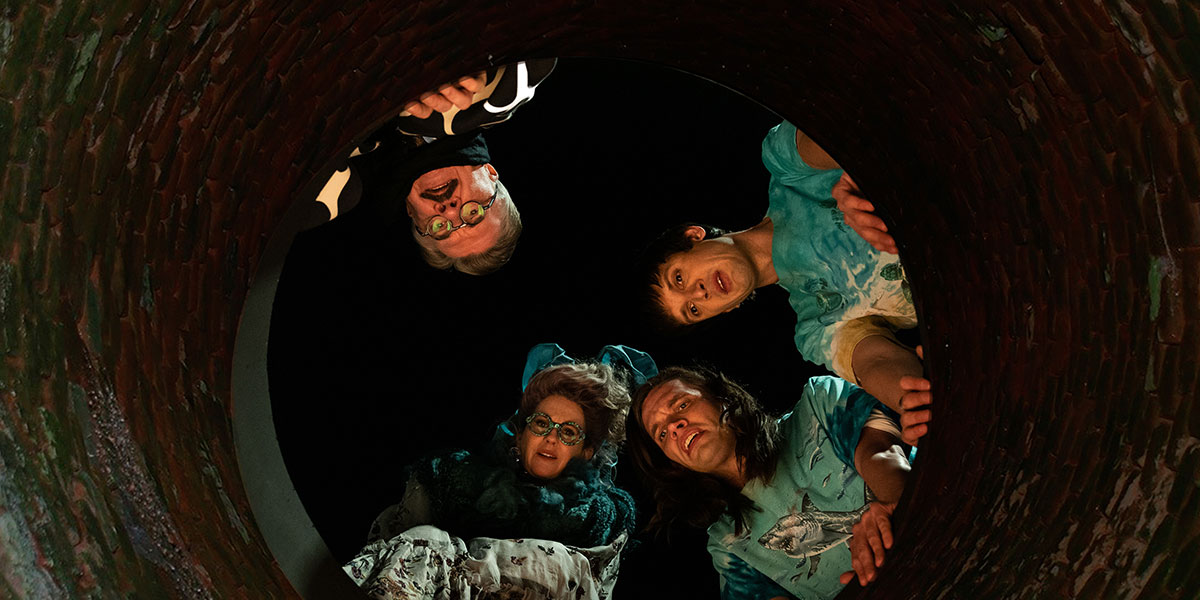
DICKS: THE MUSICAL (2023)
But the movies often started late, and the subway stopped early, and walking home after 2 in the morning was often chilly and tiring. I stopped that automatic habit when I realized I was twice as likely to stay awake through the next day’s offerings if I didn’t go to them, and got home AROUND midnight. (There’s very little that makes one feel stupider than flying 3000 miles to go to a festival, finding a good seat in the theater of a highly anticipated film, feeling perky and hydrated and caffeinated, and them mysteriously dropping off at some point.)
TIFF has continued to evolve. It now happens within a very few blocks of King Street, for the public, mostly west of the Bell Lightbox built by the real estate wing of the Ivan and Jason Reitman family. Many public screenings are held at legitimate theaters, with occasionally dodgy sightlines (especially at the enormous Roy Thomson Hall, designed as a concert hall). There’s a sort of shadow festival for the press a few blocks north on Richmond Street at a multiplex that has 14 theaters with marvelous screens. (Which are largely programmed with public screenings at night.)
The scholarship of the now-doorstopper program is so impressive that a recent de-accessioning of my extensive collection of festival catalo gues resulted in tossing out almost everything except my TIFF catalogues — which now cost $50 and are actually sold only in the Bell Lightbox bookstore. When I expressed surprise this year that the Industry pass no longer came with a free copy of the catalogue – I was picking up industry passes for two friends – the very helpful volunteer told me “The Festival now regards them as collector’s items.” It’s been clear for several years that TIFF wants to get out of the publishing business, and no longer offers the very useful printed Schedules that I used all day long. There’s an online schedule app, but it drains one’s batteries so quickly that one walks past grim-faced attendees sitting on the carpeted floor, plugged into one of the few outlets available. (I would pay $50 for a schedule as well as a catalogue.)
The evolution of TIFF continues: it was announced just this year that a film Market will start in 2026.
But the general generosity and ease of TIFF, as well as its overstuffed, enticing programming, is why I find myself recommending TIFF above all other festivals when asked for a recommendation. For my American friends, well, it’s in an English-speaking country, easy to access, and cheaper to stay in than New York or Chicago. The festival has featured as many as 400 different films of all lengths and that is both alluring and frustrating — the serious filmgoer might manage to see 50, in ten days. Many years ago, when critic Harlan Jacobson quipped in print that the then rather sparse New York Film Festival was not occurring in New York, but in Toronto, New York paid attention and added many more movies and sidebars to its programming.
I also add that while I used to go to Toronto to get a glimpse of the current state of world cinema, I now also go in search of great projection in wonderful theaters with large and enthusiastic audiences whose attention is wholly directed towards the screen. Great screens do not abound in my part of the world – in fact, the adjacent city of Berkeley lost ALL of its once-twenty commercial downtown screens since Covid, and now only boasts one three-screen multiplex miles east of downtown, two screens of which I find beneath contempt. The downtown Berkeley Art Museum/Pacific Film Archive still offers its superb repertory programming five days a week.
I also used to avoid movies that I knew were soon coming to streaming services, but that is no longer the case. I now want to see the latest Netflix or Amazon Prime offering with those full audiences, instead of in my room on the 60-inch flat screen. (When it was installed, I called my father and said “I should have gone for the 65-inch.” And he relied “But 70 would be vulgar!” I laughed. But now I want to GO BIGGER!)
I dream of Toronto and TIFF. I am already looking forward to next year’s edition.
For a look at the 2024 schedule go here. You go through it day by day and clock on titles for details. The films can also be looked at alphabetically.

Meredith Brody, a graduate of both the Paris Cordon Bleu cooking school and USC film school, has been the restaurant critic for, among others, the Village Voice, LA Weekly, and SF Weekly, and has written for countless film magazines and websites including Cahiers du Cinema, Film Comment, and Indiewire. Her writings on books, theater, television, and travel have appeared in the New York Times, the Los Angeles Times, and Interview. She also contributes to EatDrinkFilms including her“Meals with Meredith,” where she talks about food and film with filmmakers at restaurants in northern California, writes about vintage cocktails and where she eats during film festivals at the Castro Theatre in San Francisco. A selection of her EDF pieces are found here.
One could describe Meredith as “hooked on cinema” as she attends four-five films a day at many bay area and international festivals each year. Somebody has to do it. Read about her journey back to festivals after two years in pandemic mode.
 eatdrinkfilms.com